TV Wall Mount Installation on Drywall: Tips and Safety Guide
Installing a TV on a wall can transform the look of a room, save floor space, and create a cleaner entertainment setup. However, TV wall mount installation on drywall requires careful planning to make sure the television is mounted securely and positioned correctly.
Drywall itself is not usually strong enough to support a heavy television without appropriate mounting hardware or structural support behind it. Before installing a wall mount, you need to consider the TV’s weight, VESA pattern, wall construction, mounting bracket, stud locations, viewing height, and cable management.
Whether you are mounting a 43-inch TV in a bedroom or a large 75-inch screen in a living room, choosing the right installation method is essential.
This guide explains how to mount a TV on drywall, how to find studs, when drywall anchors can be used, how to choose the right TV wall mount, and which safety mistakes to avoid.
TV Wall Mount Installation on Drywall
Can You Mount a TV on Drywall?
Yes, you can mount a TV on drywall, but the correct installation method depends on the television, wall construction, and mounting system.
In most cases, the strongest approach is to attach the TV wall mount to suitable structural support behind the drywall, such as wood studs or an appropriate structural framing system. The drywall is primarily the finished wall surface, while the framing behind it provides structural support.
Some TV mounting systems are specifically designed to work with heavy-duty drywall anchors. However, you should only use an anchor system when it is specifically rated for the TV, mounting bracket, drywall type, and installation method.
Before starting a drywall TV mount installation, check:
- TV weight
- TV size
- VESA mounting pattern
- Wall mount weight capacity
- Type and thickness of drywall
- Stud or framing locations
- Type of wall construction
- Electrical outlet location
- Cable routing
- Desired viewing height
- Type of TV mount
TV Wall Mount Installation on Drywall
If the wall structure is uncertain or the TV is particularly large or heavy, professional TV installation can help ensure the mounting system is appropriate.
Why TV Wall Mount Installation on Drywall Requires Care
A mounted TV does more than simply hang from a wall. The bracket transfers the weight and movement of the television to the wall.
This becomes especially important with full-motion TV wall mounts. When a TV is pulled away from the wall, the bracket creates additional leverage on its mounting points. A fixed TV mount generally creates less movement because the television remains close to the wall.
An incorrectly installed mount can result in:
- A loose or unstable TV
- Damage to drywall
- Damage to the wall structure
- Damage to cables
- An uneven television
- The mounting bracket pulling away from the wall
TV Wall Mount Installation on Drywall
Proper installation starts by understanding the wall rather than simply drilling holes and attaching a bracket.
How to Find Studs Behind Drywall
Finding suitable structural support is one of the most important parts of mounting a TV on drywall.
A stud finder can help locate wood or metal framing behind the drywall. Once you identify a possible stud, follow the stud-finder manufacturer’s instructions to verify its location.
The mounting holes on the TV bracket should then be compared with the available structural support.
The exact spacing of studs can vary, so do not assume that every wall has the same configuration.
When possible, position the wall mount so that its appropriate mounting points align with suitable structural framing.
TV Wall Mount Installation on Drywall
Why Studs Matter
Drywall is relatively thin compared with the structure supporting the wall. A fastener installed only into the drywall may not provide enough support for a television, particularly when the TV is heavy or mounted on an articulating bracket.
For this reason, stud mounting for a TV is often preferred when the wall construction allows it.
If the studs do not line up with the mounting holes on your bracket, there may be other engineered installation solutions, but they should be compatible with the specific TV mount and wall construction.
Can You Mount a TV on Drywall Without Studs?
Sometimes, but it depends on the mounting system.
Certain TV mounts are designed for installation using specialized drywall anchors. These systems have specific weight limits and installation requirements.
TV Wall Mount Installation on Drywall
You should never assume that a standard plastic drywall anchor is suitable for mounting a television.
Before using an anchor-only installation, verify:
- The anchor is designed for the type of drywall being used.
- The anchor has an appropriate load rating.
- The TV’s weight is within the mounting system’s specifications.
- The TV mount manufacturer permits that installation method.
- The installation follows the manufacturer’s instructions.
Large TVs and full-motion mounts require particular attention because their weight and leverage can place greater demands on the mounting points.
When there is any uncertainty about the wall structure, professional assessment is the safer approach.
TV Wall Mount Installation on Drywall
Choose the Right TV Wall Mount
Not every TV wall mount is suitable for every television.
When choosing a mounting bracket, check the manufacturer’s specifications for:
- Maximum supported weight
- Compatible TV size
- VESA pattern
- Mounting configuration
- Required wall type
- Extension range
- Tilt range
- Swivel range
The mount should be compatible with both the television and the wall where it will be installed.
Fixed TV Wall Mount
A fixed mount keeps the television close to the wall.
It is often suitable for rooms where viewers sit directly in front of the TV and do not need to adjust the screen.
Benefits include:
TV Wall Mount Installation on Drywall
- Low-profile appearance
- Minimal distance from the wall
- Simple design
- Clean installation
Because the TV stays close to the wall, fixed mounts generally have less movement than articulating mounts.
Tilting TV Wall Mount
A tilting mount allows the screen to angle up or down.
This can be useful when a television is installed higher than the preferred viewing position or when room lighting creates glare.
A tilting mount can provide more flexibility while keeping the TV relatively close to the wall.
Full-Motion TV Wall Mount
A full-motion mount allows the television to swivel, tilt, and extend from the wall, depending on the model.
This can be useful in rooms where viewers watch the TV from different seating positions.
However, the extended position can create additional leverage on the wall mounting points. The bracket and wall structure therefore need to be suitable for the installation.
TV Wall Mount Installation on Drywall
Check the TV’s VESA Pattern
The VESA pattern is another important specification to check before purchasing a TV wall mount.
VESA dimensions describe the horizontal and vertical spacing between the mounting holes on the back of a compatible TV.
Common VESA patterns include:
- 200 × 200 mm
- 300 × 300 mm
- 400 × 200 mm
- 400 × 400 mm
- 600 × 400 mm
These are examples only, and your TV may use a different configuration.
Check the television’s user manual or manufacturer’s specifications before purchasing the bracket.
A wall mount must support the TV’s VESA pattern as well as its weight.
TV Wall Mount Installation on Drywall
Check the Weight Capacity of the Wall Mount
The TV’s weight is more important than screen size when determining whether a mounting bracket is suitable.
For example, two televisions with the same screen size may have different weights and different VESA configurations.
Always compare the TV’s specifications with the wall mount’s:
- Maximum weight capacity
- Supported screen size
- VESA compatibility
- Wall-type requirements
Avoid selecting a bracket based solely on the advertised screen size.
TV Wall Mount Installation on Drywall
What Is the Best Height for a Wall-Mounted TV?
There is no universal TV mounting height because room layouts and seating positions vary.
For many living rooms, a practical starting point is to position the center of the screen around the viewer’s natural eye level while seated.
However, the final height also depends on:
- Sofa height
- Viewer height
- TV size
- Viewing distance
- Furniture below the TV
- Room layout
- Fireplace location
Before drilling, mark the proposed position and sit in the primary viewing area.
This simple step can help you determine whether the TV feels too high or too low.
How to Install a TV Wall Mount on Drywall
TV Wall Mount Installation on Drywall
The exact installation procedure varies by bracket and wall construction. Always follow the instructions supplied with your specific TV mount.
The following process provides a general overview.
Step 1: Check the TV and Mount Specifications
Confirm the TV’s weight, VESA pattern, and dimensions.
Then verify that the wall mount supports the television.
Do not begin drilling until the TV and bracket have been confirmed as compatible.
Step 2: Choose the Installation Location
Select a wall location that provides a comfortable viewing position.
TV Wall Mount Installation on Drywall
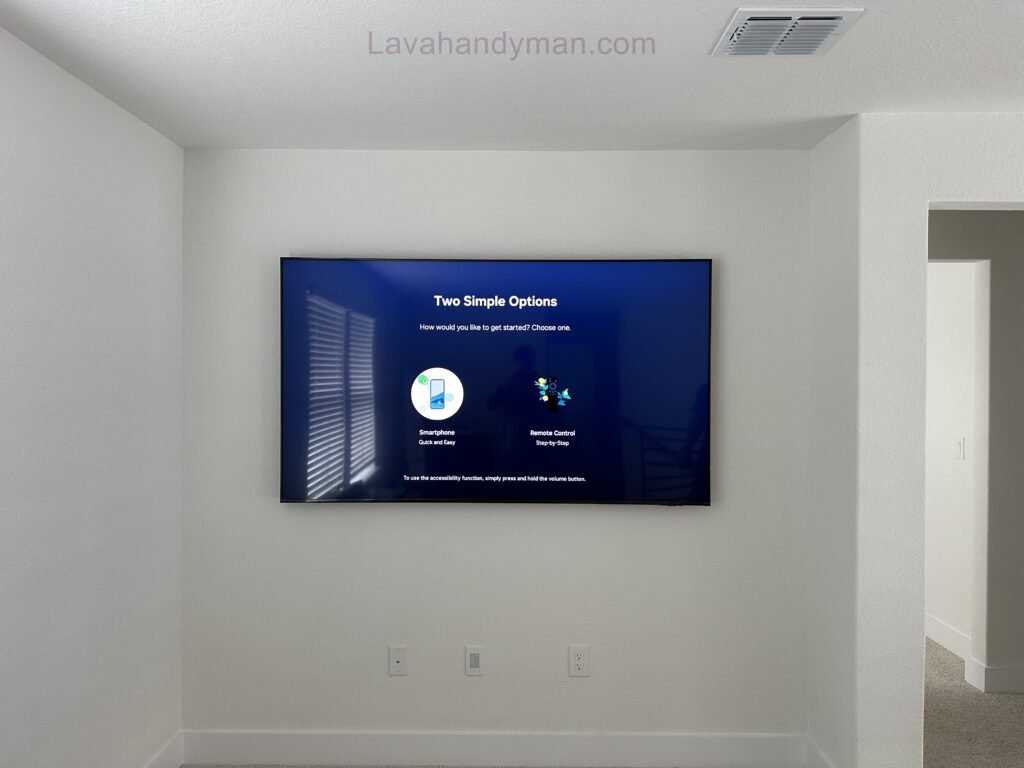
Consider windows, lighting, furniture, doors, electrical outlets, and cable connections.
Make sure the TV will not interfere with other objects in the room.
Step 3: Locate the Wall Studs
Use an appropriate stud-finding method to identify suitable structural support.
TV Wall Mount Installation on Drywall
Mark the stud locations clearly.
Compare these locations with the mounting holes on the TV bracket.
Step 4: Check for Electrical Wiring and Plumbing
Before drilling, consider the possibility of electrical cables, plumbing, or other utilities behind the drywall.
Never drill blindly into a wall.
If you cannot confidently determine whether the drilling area is safe, stop the installation and seek professional assistance.
Step 5: Position and Level the Bracket
Hold the mounting bracket in the selected position and mark the appropriate mounting points.
Use a level to make sure the bracket is straight.
Careful measuring at this stage can prevent an uneven TV later.
Step 6: Install the Mounting Hardware
TV Wall Mount Installation on Drywall
Use only the hardware specified or approved by the wall-mount manufacturer for the particular wall construction.
Install the fasteners according to the manufacturer’s instructions.
Avoid over-tightening hardware, which can damage the wall or mounting components.
Step 7: Attach the Mounting Brackets to the TV
Attach the appropriate mounting arms or brackets to the back of the television.
Use the correct screws and spacers specified for your TV and mounting system.
Do not force screws into the TV.
TV Wall Mount Installation on Drywall
Step 8: Attach the TV to the Wall Mount
Large televisions should generally be handled by two or more people, depending on their size and weight.
Carefully attach the TV to the wall bracket according to the manufacturer’s instructions.
Make sure all safety locks or retention mechanisms are properly engaged.
Step 9: Connect the Cables
Connect HDMI, Ethernet, antenna, power, and other required cables.
Leave enough cable slack if you are using a tilting or full-motion mount.
Cables should not be pulled tightly when the TV moves.
TV Wall Mount Installation on Drywall
Step 10: Inspect the Installation
Check that the television is level and securely attached.
Test the mount carefully according to its intended range of movement.
Look for signs of movement, loose hardware, or cable tension.
If anything appears unstable, stop using the TV until the problem has been corrected.
TV Cable Management After Wall Mounting
One of the main reasons homeowners choose a wall-mounted TV is to achieve a cleaner appearance.
Cable management can help keep the installation organized.
Common options include:
TV Wall Mount Installation on Drywall
- Cable sleeves
- Cable clips
- Surface-mounted cable channels
- Concealed cable-management systems
- Properly positioned wall outlets
If electrical wiring needs to be installed inside the wall, it should comply with applicable electrical codes and safety requirements.
Do not place ordinary extension cords inside walls unless the product is specifically designed and approved for that purpose.
For permanent electrical modifications, use a qualified electrician where required.
Common TV Wall Mounting Mistakes to Avoid
Even a good-quality TV mount can become unsafe if it is installed incorrectly.
Using Unsuitable Drywall Anchors
Not every drywall anchor can support a television.
TV Wall Mount Installation on Drywall
Always check the anchor’s specifications and whether it is approved for the intended TV mounting application.
Mounting Only Into Drywall Without Checking the Requirements
Before choosing an anchor-only installation, verify that the mounting system is designed for it.
For many installations, suitable structural support is preferred.
Ignoring the TV’s Weight
Screen size does not tell you how heavy the TV is.
Always check the actual weight against the bracket’s maximum supported load.
Choosing the Wrong VESA Pattern
A bracket may support the correct screen size but still be incompatible with the TV’s VESA pattern.
Check both specifications before purchasing.
TV Wall Mount Installation on Drywall
Mounting the TV Too High
A television that is too high can create an uncomfortable viewing position.
Evaluate the proposed height from the primary seating area before drilling.
Forgetting Cable Clearance
Plan the cable connections before mounting the television.
Some TV ports face sideways, downward, or directly backward. The mounting bracket needs to leave sufficient clearance for the connectors.
Failing to Level the Mount
A small angle can be noticeable after the TV is installed.
Use a reliable level when positioning the bracket.
TV Wall Mount Installation on Drywall
Using a Full-Motion Mount Without Considering Wall Support
An articulating bracket can create additional leverage when the TV is extended.
The wall structure and mounting hardware must be suitable for that application.
TV Wall Mount Installation on Different Wall Types
Drywall can be installed over different types of structures, and the correct mounting method depends on what is behind the surface.
Standard Drywall
TV Wall Mount Installation on Drywall
Standard drywall is often attached to wood or metal framing.
When suitable structural framing is available, the mounting bracket can be installed according to the mount manufacturer’s requirements.
Drywall Over Masonry
Some walls have drywall installed over masonry.
In this situation, the actual structure behind the drywall should be identified before choosing the mounting hardware.
The appropriate fasteners may be different from those used for a conventional framed wall.
TV Wall Mount Installation on Drywall
Metal Stud Walls
Metal studs require careful consideration because they behave differently from wood framing.
The appropriate mounting system depends on the size and type of framing, the wall construction, and the TV mount.
Do not assume that hardware intended for wood studs is suitable for every metal-stud installation.
Is Professional TV Wall Mount Installation Worth Considering?
Professional installation can be particularly useful when the wall structure is difficult to identify or when the television is large or heavy.
A professional TV mounting service can help with:
- Identifying suitable mounting locations
- Selecting an appropriate bracket
- Installing the mounting hardware
- Positioning the TV at a practical height
- Cable management
- Leveling the television
- Working with unusual wall construction
TV Wall Mount Installation on Drywall
Professional installation can also be useful for full-motion mounts, large televisions, multiple-TV installations, and difficult cable-routing situations.
If you are unsure about the structural integrity of the wall or the correct mounting method, it is better to resolve those questions before attaching the television.
TV Wall Mount Installation Above a Fireplace
Mounting a TV above a fireplace requires additional planning.
The area above a fireplace may become warmer than other parts of the wall, and the TV may be positioned higher than the ideal viewing height.
Before installing a television above a fireplace, check the fireplace manufacturer’s requirements and the TV manufacturer’s recommendations.
You should consider:
TV Wall Mount Installation on Drywall
- Heat exposure
- Viewing angle
- Wall construction
- Cable routing
- TV mounting height
- Fireplace clearance requirements
A tilting TV mount may provide a more practical viewing angle when the TV must be positioned higher than usual.
How to Keep a Wall-Mounted TV Secure
TV mounting is not necessarily finished the moment the television is attached to the wall.
Periodically inspect the installation for signs of problems.
Look for:
TV Wall Mount Installation on Drywall
- Loose mounting hardware
- Unexpected movement
- Changes in the TV’s position
- Damage around mounting points
- Cable damage
- A bracket that appears to pull away from the wall
If you notice unusual movement or damage, stop using the installation and have it inspected.
Do not simply tighten random screws without determining why the mount has become loose.
Frequently Asked Questions About TV Wall Mount Installation on Drywall
Can you mount a TV directly to drywall?
A TV should not automatically be attached directly to drywall with ordinary screws. The correct method depends on the TV’s weight, the wall construction, and the mounting system. Suitable structural support or an appropriately rated mounting system should be used.
TV Wall Mount Installation on Drywall
Do you need studs to mount a TV?
Studs or other suitable structural support are commonly preferred for TV mounting. However, some mounting systems are specifically designed for approved drywall-anchor installations. Always follow the requirements of the specific mount.
Can you mount a 65-inch TV on drywall?
Yes, a 65-inch TV can potentially be mounted on drywall. However, the screen size alone does not determine whether the installation is suitable. You also need to consider the TV’s weight, VESA pattern, mounting bracket, wall construction, and mounting hardware.
What is the best TV wall mount for drywall?
The appropriate TV wall mount depends on the television, wall construction, desired viewing position, and whether you want a fixed, tilting, or full-motion installation.
How high should a TV be mounted?
TV Wall Mount Installation on Drywall
The ideal height depends on the room and seating arrangement. A common approach is to position the center of the screen close to the viewer’s eye level while seated, while also considering furniture and other room features.
Can you hide TV cables inside drywall?
TV cables can sometimes be routed through a wall using products and installation methods designed for in-wall use. Electrical installations must comply with applicable local codes and safety requirements.
Is a full-motion TV mount safe on drywall?
A full-motion TV mount can be installed on a drywall wall when the mounting system, wall structure, hardware, and TV weight are all appropriate for the application. Because an extended arm creates additional leverage, careful installation is particularly important.
How much does TV wall mount installation cost?
The cost of TV wall mount installation varies depending on factors such as TV size, wall construction, mount type, cable management, installation location, and whether additional structural or electrical work is required. A local installer can provide a more accurate estimate based on the specific installation.
TV Wall Mount Installation on Drywall
Final Thoughts on TV Wall Mount Installation on Drywall
A successful TV wall mount installation on drywall starts with understanding the wall and selecting the correct mounting system.
Before installing your TV, verify its weight and VESA pattern, choose a compatible bracket, identify suitable structural support, check for potential electrical and plumbing hazards, and determine a comfortable viewing height.
Avoid relying on generic hardware or assumptions about what the wall can support. The correct installation method depends on the specific TV, mounting bracket, drywall, and structure behind the wall.
For large televisions, full-motion mounts, unusual wall construction, or installations where you cannot confidently identify suitable support, professional TV mounting can help ensure that the installation is secure and properly positioned.
When the correct hardware, mounting method, and safety procedures are used, a wall-mounted TV can provide a clean appearance, improve the use of available space, and create a more organized entertainment area.
TV Wall Mount Installation on Drywall
TV Wall Mount Installation Checklist
Before considering the installation complete, verify the following:
- The TV weight has been checked.
- The TV’s VESA pattern matches the wall mount.
- The wall mount supports the TV’s weight and size.
- Suitable structural support has been identified.
- The mounting location has been checked for potential utilities.
- The TV height has been evaluated from the main seating position.
- The bracket is properly leveled.
- Manufacturer-approved mounting hardware has been used.
- The TV is securely attached to the bracket.
- All locking mechanisms are engaged.
- Cables have enough slack and are not under tension.
- The final installation has been checked for stability.
- Any electrical work complies with applicable local requirements.
📞 Need Help?
Let us take care of the hard work while you sit back and relax.
📍 Serving: Austin, Round Rock, Cedar Park & more
📱 Call or Text: (737) 420-6992
🌐 Visit: https://lavahandyman.com